

Quick Answer
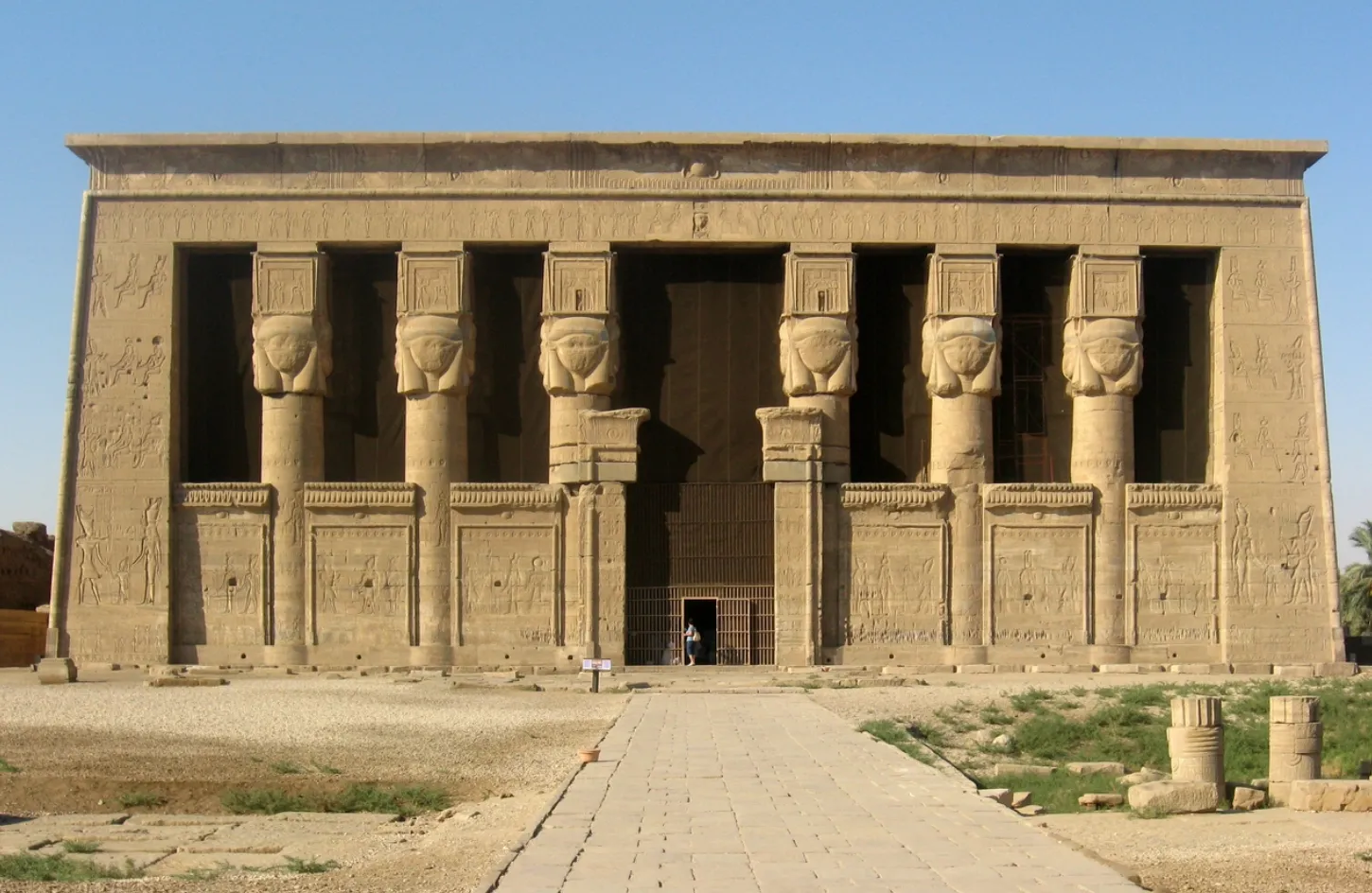
One of the most preserved temple complexes in ancient Egypt is the Dendera Temple complex, situated 60 km north of Luxor close to Qena. Constructed mainly during the Ptolemaic and Roman era (1st century BCE – 1st century CE), it is a temple complex devoted to the Egyptian goddess Hathor, who represents love, music, and healing. Known for the Dendera Zodiac ceiling (replica; the original is kept at the Louvre), colorful depictions of astral phenomena, and 12 subterranean crypts. Admission fee: EGP 180 for tourists. Additional fee for crypts: EGP 100. Access to the roof has been restricted since November 2025 due to restoration work.
Mohamed Atta, specialist for Upper Egypt at Nile Cruise Offers, has been taking his cruise guests to Dendera for more than ten years now — although not as many as one would expect. “It takes 90 minutes return from where the main Luxor cruise stops are,” he explains, “and that is precisely why it makes visiting it worthwhile. The temples that everybody sees are incredible. Dendera is incredible and peaceful.” This guide tells you all you need to know to visit Dendera, even if your usual Nile cruise itinerary does not feature it.
Dendera Temple Complex — Key Facts at a Glance
| Fact | Detail |
|---|---|
| Ancient Egyptian name | Iunet or Tantere (Greek: Tentyra) |
| Ubicazione | West bank of the Nile, 2.5 km SE of Dendera town, near Qena — 60 km north of Luxor |
| Total complex area | 40,000 square metres, surrounded by a mudbrick enclosure wall |
| Primary deity | Hathor — goddess of love, music, joy, fertility, and healing |
| Main construction period | Late Ptolemaic and Roman era (c.54 BCE – 1st century CE) |
| Earlier structures | Evidence of building from the Old Kingdom (c.2250 BCE, reign of Pepi I) |
| UNESCO listing | 1979 (part of Ancient Thebes & Necropolis — broader Upper Egypt listing) |
| Standard entrance ticket (foreign) | EGP 180 |
| Standard entrance ticket (Egyptian) | EGP 30 |
| Crypt access (extra ticket) | EGP 100 — highly recommended |
| Rooftop status (2026) | Closed for restoration since November 2025 — no access |
| Opening hours (summer) | 7:00 AM – 5:00 PM (April–September) |
| Opening hours (winter) | 7:00 AM – 4:00 PM (October–March) |
| Typical visit duration | 1.5–2.5 hours (main temple + crypt) |
| Distance from Luxor | 60 km north — approx. 1 hour by car |
| Distance from Abydos | 90 km south of Abydos — often combined as a day trip |
| Photography | Permitted throughout; no flash in crypts |
| Best time of day | Morning (temple interior stays cool; afternoon heat is intense) |
Rooftop Closed — November 2025 Onwards
The rooftop area of Dendera Temple, which includes the renowned Osiris Chapels and the Ceiling of the Zodiac, has been closed to visitors since November 2025 because of renovation and preservation work. There has not been any official date announced yet, as of June 2026, regarding when it will reopen. Any information about visiting the rooftop of the temple should be regarded as out of date by now.
What Makes Dendera Different from Other Egyptian Temples
There are about 300 ancient Egyptian temples in existence today. They are all in ruins: fallen columns, collapsed lintels, and walls that only rise to halfway up their original height. Dendera is an exception.
The Temple of Hathor at Dendera is among a select few ancient Egyptian temples in which the entire architectural plan — the roof, the walls, the columns, and the sanctuary — still exists intact. The mudbrick wall enclosed the whole temple complex, making it safe from the looting and destruction carried out by robbers and builders through many centuries. Desert sands covered the whole building throughout the Middle Ages, thereby protecting the interior paintings from sunlight exposure.
There is one further classification of these temples that must be made. Most Egyptian temples we can see today are monuments of the New Kingdom, dating back to the 18th–20th Dynasties (circa 1550 BCE–1070 BCE): Karnak, Luxor, and Abu Simbel temples belong to that category. The structures you see at Dendera belong to the Ptolemaic and Roman periods, centuries after the New Kingdom.
This gives Dendera Temple a different visual impression: the proportions are different, the style of relief carving is a bit newer, and the iconographic program shows how complicated the religious theology of that time was, when Egypt, Greece, and Rome were combining their traditions. You can see it in the columns’ faces — for example, the face of Hathor, represented with cow ears, is carved in a somewhat more Hellenistic style.
None of this makes Dendera Temple inferior to other temples. On the contrary, it makes it unique, because its completeness gives visitors the opportunity to walk inside an ancient closed temple as it was originally meant to be experienced.
History of Dendera Temple: From Old Kingdom to Roman Emperors
Four Thousand Years on the Same Ground
The Dendera site has been considered holy land for more than 4,000 years. Archaeological finds, including pieces of Old Kingdom masonry, show that a sanctuary existed on this site during the reign of Pepi I, around 2250 BCE. Pharaohs of the Middle Kingdom built here too. A small sanctuary was constructed by Thutmose III during the New Kingdom. However, most of what visitors see today belongs to the late Ptolemaic era and the first two centuries of the Roman period.
Construction of the main temple began during the reign of Ptolemy XII, father of Cleopatra VII, in 54 BCE, and continued under successive Roman emperors. Augustus, Tiberius, Claudius, Nero, Domitian, and Trajan added reliefs and chambers to the temple, presenting themselves not as Roman rulers but as ancient Egyptian pharaohs offering gifts to Hathor. This made political sense — patronizing temples gave rulers legitimacy in the eyes of the local population. The building program lasted roughly three centuries.
Cleopatra VII at Dendera
The rear exterior wall of the Temple of Hathor contains one of the most politically loaded scenes in all of Egypt: a large relief depicting Cleopatra VII and her son Caesarion, fathered by Julius Caesar, offering gifts to Hathor. This is one of very few surviving depictions of one of history’s most famous women shown in Egyptian pharaonic dress rather than Hellenistic style. The figures are monumental in scale, and details such as Cleopatra’s double crown, collar, and gestures are carefully rendered.
The Dendera Zodiac and the French Removal
During the Napoleonic campaign in Egypt in 1799, a group of scholars noticed an unusual circular ceiling relief in the portico of the Osiris chapel on the temple roof — the Dendera Zodiac, which depicted the constellations of the ancient Egyptian night sky, including twelve zodiac signs still recognizable today, such as the bull of Taurus, the scales of Libra, and the scorpion of Scorpius.
In 1820, a French expedition removed the Dendera Zodiac from the ceiling. Whether official permission was granted remains disputed. The zodiac was shipped to France and purchased by King Louis XVIII. It has been housed in the Louvre in Paris since 1822.
Today’s visitors can see the Dendera Zodiac in the form of an exact replica installed under the ceiling of the same portico in the Osiris chapel. The reproduction is accurate, and the dim setting of the chapel recreates the atmosphere of the original context — but the original itself remains in Paris.
Medieval Period and Rediscovery
In early Christian times, a church was built within the temple walls; traces of it remain in the northeastern part of the structure. Medieval Arab texts mention the site, but it was largely buried in sand and debris by the 18th century, when European explorers began visiting Egypt in large numbers. Giovanni Battista Belzoni worked to uncover parts of the temple in the early 19th century.
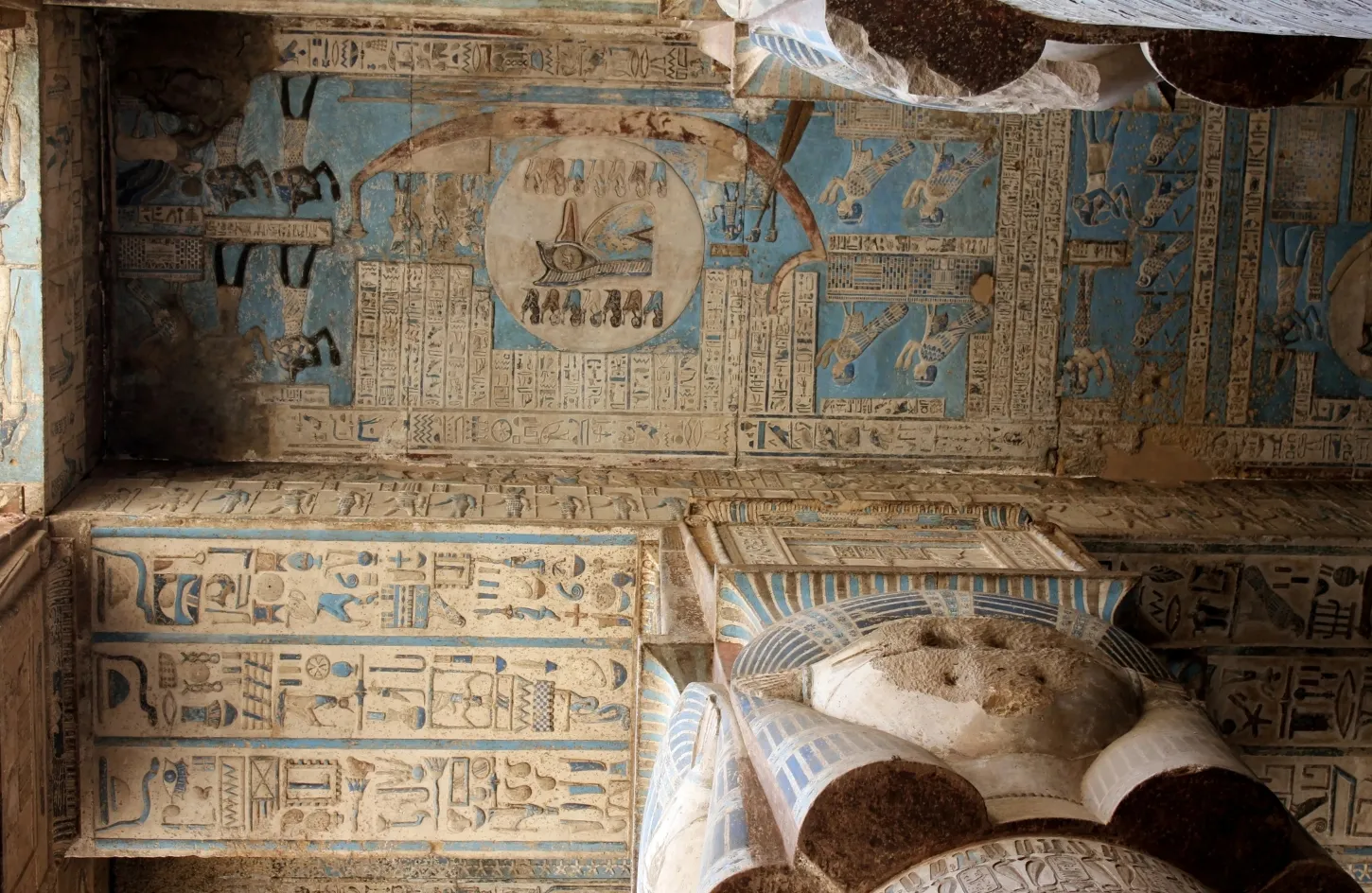
Restoration projects, carried out jointly by the Egyptian Ministry of Tourism and Antiquities and French archaeological teams, have recently removed centuries of dirt and soot from the temple’s interior ceilings, revealing painted surfaces in colors more vivid than they have appeared since antiquity. Restoration work is ongoing as of 2026; sections that appeared black in photographs taken just ten years ago have revealed bright blue, red, and gold pigments beneath layers of grime.
Inside the Temple of Hathor — Room by Room
The Facade and Outer Hypostyle Hall
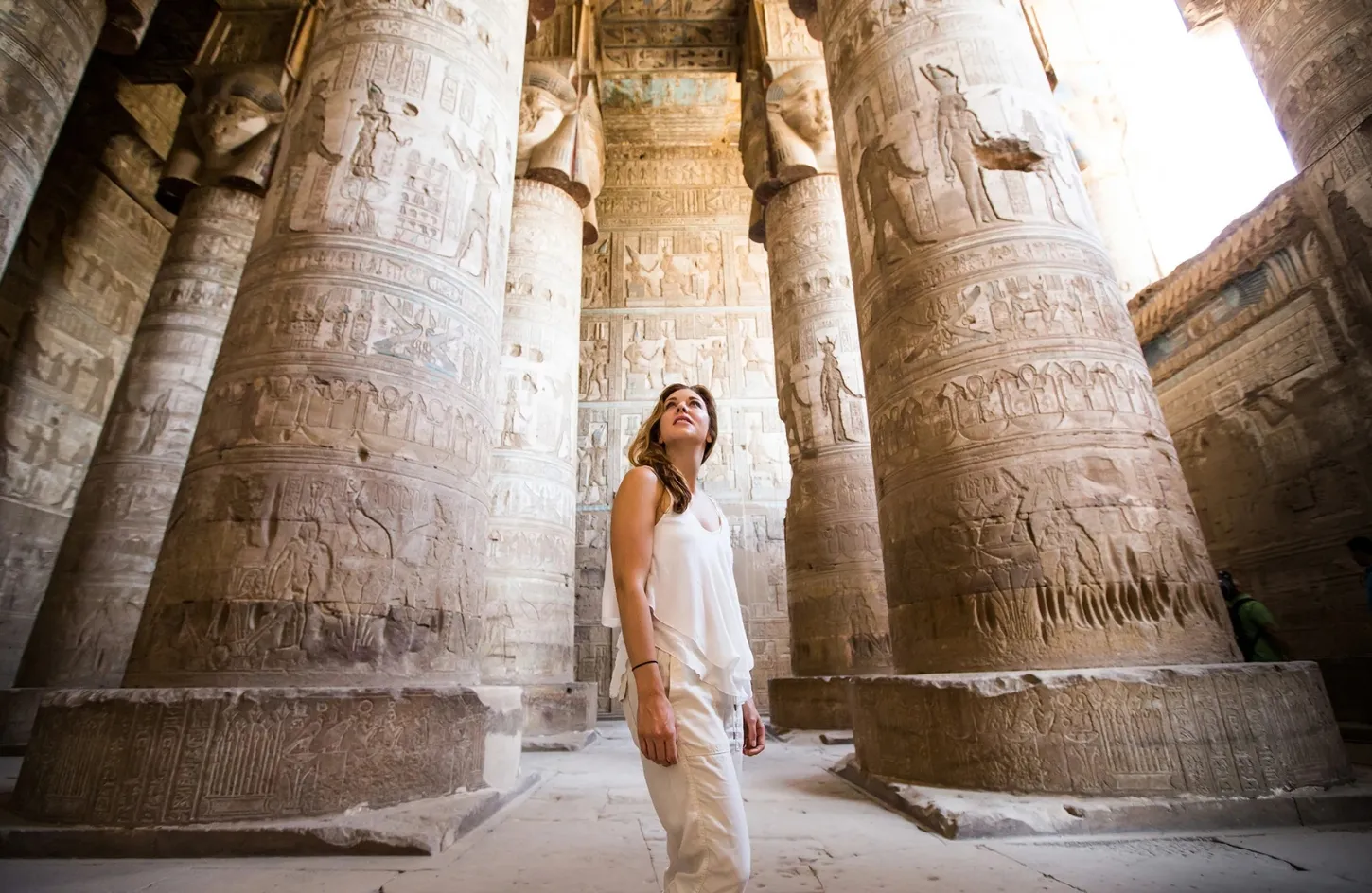
The temple’s entrance is immediately striking: rather than a pylon entrance typical of other Egyptian temples, visitors step directly into the hypostyle hall, with its six massive columns topped by Hathor-head capitals. Each capital has four Hathor faces looking toward the cardinal directions. In total, the inner and outer hypostyle halls contain 18 columns decorated the same way, forming a forest of Hathor faces watching visitors as they pass through.
The ceiling of the outer hypostyle hall carries famous astronomical decorations — a blue background filled with celestial symbols and figures representing the solar boat’s passage through the heavens. This is a separate astronomical scene from the zodiac ceiling (which is on the now-closed roof), but is of equal artistic quality. Recent restoration has returned much of its original vibrancy.
The Inner Hypostyle Hall and Offering Halls
Further inside, the ceiling lowers and the light dims — a deliberate architectural choice symbolizing the transition from the public realm (the outer hypostyle hall, open to worshippers) to the sacred realm (the inner sanctuary, reserved for priests). The walls are decorated with ritual scenes: pharaohs making offerings to Hathor, Hathor shown in various forms, and depictions of the mythological relationship between Hathor and Horus of Edfu.
A notable feature of the interior halls is the relief carving technique — raised relief, common in the Ptolemaic period, in which figures project outward from the wall surface rather than being cut into it. Much of the original paint survives in these halls because the solid stone roof has shielded it from UV exposure.
The Sanctuary
The innermost room, known as the naos or sanctuary, is a small, completely dark stone chamber that once held the sacred image of Hathor. Only the high priest was permitted to enter. Its walls bear some of the most sacred texts and imagery in the entire temple. Standing in the sanctuary — knowing the room was opened only once a day, in a ceremony known as the “Opening of the Shrine” performed throughout Egypt each morning for thousands of years — is a genuinely powerful moment for many visitors.
The Osiris Chapel and the Zodiac Replica
The stairway to the rooftop, currently closed for renovation, is located at the rear of the temple. Once reopened, this level offers access to two small chapels dedicated to Osiris, decorated with scenes of his resurrection, and to the portico housing the Dendera Zodiac replica. The replica is worth seeing on its own merits, since it demonstrates, in architectural terms, how a circular representation of the sky was fitted into a rectangular ceiling scheme.
Even while the rooftop remains closed, the Osiris chapel area within the upper part of the temple can sometimes be reached via internal stairs — ask your guide about current access.
The Dendera Zodiac: Astronomy, Controversy, and Where It Is Now
The Dendera Zodiac is the most discussed object associated with the temple, and, for many visitors, the most confusing, since the original piece is no longer on site.
What the Zodiac Shows
The Dendera Zodiac is a circular relief roughly 2.5 meters in diameter, originally set into a ceiling slab in the portico of the Osiris chapel. It depicts the Egyptian sky as understood in the late Ptolemaic period, with astronomical calculations of the constellations’ positions pointing to a conception date around 50 BCE.
The relief has several layers: 36 decans representing ten-day periods of the Egyptian calendar, twelve zodiac signs rendered in Egyptian style (a bull for Taurus, a scarab for Cancer, a lion for Leo), and a central field showing Egyptian constellations, including the goddess Taweret with her mooring stake, Anubis, and the falcon of Horus.
Scholars accompanying Napoleon’s expedition were the first to identify the zodiac symbols and attempted to date the relief astronomically. Their conclusion — a first-century BCE date — conflicted with the then-prevailing belief that Egyptian civilization predated Greek civilization, sparking academic debate that lasted decades. The carving’s astronomical reference point is now generally placed around 50 BCE.
The Controversy: Was It Stolen?
The 1820 removal of the Dendera Zodiac remains one of the most controversial episodes in early Egyptology. It was removed under the direction of Sébastien Louis Saulnier and carried out by sculptor Jean-Baptiste Lelorrain, who cut the relief from the ceiling using saws and gunpowder over roughly 22 days. Whether Egypt’s ruler, Muhammad Ali Pasha, granted official permission is disputed — some accounts confirm it, others deny it.
Unlike the Elgin Marbles or the Nefertiti Bust, Egypt has not made a formal request for the zodiac’s return. It remains on display in a glass case in the Sully Wing of the Louvre (Room 12, ground floor). What remains at Dendera today is a well-placed and accurate — but replica — plaster cast.
The “Dendera Light” — Setting the Record Straight
One popular fringe theory holds that certain crypt carvings at Dendera depict ancient electric light bulbs, suggesting the ancient Egyptians possessed advanced electrical technology. The carvings in question show elongated oval shapes atop lotus-flower stalks, which proponents of the theory interpret as filament bulbs connected by cables.
Egyptologists agree this interpretation is incorrect. The carvings depict a lotus flower with a snake emerging from it — a common motif throughout ancient Egypt symbolizing the sun god’s emergence from the primordial waters. There is no depiction of electrical components, and no evidence anywhere in the archaeological record that the ancient Egyptians understood or used electricity.
The Crypts — Are They Worth the Extra EGP 100?
Yes, but mainly for visitors interested in relief carving in an intimate, quiet setting. It helps to know what to expect.
Twelve crypts exist within the Dendera temple complex, all below ground level and built into the foundation walls. Only three are open to tourists. They originally housed sacred objects used outside of ceremonies. Because they were sealed and buried for centuries after the temple’s active period, the relief carving inside is among the best preserved in Egypt — some crypts retain remarkably vivid color, protected from sunlight and physical contact for over a thousand years.
Visiting the crypts is a different experience from the main temple. Ceilings are low, requiring visitors to stoop; corridors are narrow; and the reliefs are viewed under electric lighting. The extra ticket and physical effort required mean the crypts are rarely crowded.
Verdict: The Crypts
Worth EGP 100 without reservation for any visitor who isn’t severely claustrophobic. The preservation quality is unmatched elsewhere on site, and the experience of standing alone in a chamber sealed for a thousand years is genuinely singular.
The Rooftop — Currently Closed (Updated June 2026)
The roof of the Temple of Hathor, which provides access to the Osiris chapels and the portico housing the Zodiac ceiling replica, has been off-limits to visitors since November 2025 due to structural work and ceiling repair, part of the broader program to clean and conserve the temple’s painted surfaces.
As of this June 2026 update, no reopening date has been announced. Visitors should check with their tour provider or at the site entrance for the current status of the roof before planning a visit. The rest of the temple — outer and inner hypostyle halls, sanctuary, and crypts — remains fully accessible and represents the most significant part of the site.
Check Status Before You Go
Rooftop status may change; restoration timelines at Egyptian archaeological sites are frequently extended. A Nile Cruise Offers tour manager will have the most current information for specific travel dates. If the rooftop reopens before your visit, allow an extra 30 minutes and enter via the external staircase on the temple’s northeast side.
No trip to Luxor is complete without visiting the Valley of the Kings. Just a short drive from the Dendera Temple, this legendary royal burial site is home to the magnificent tombs of Egypt’s greatest pharaohs, including Tutankhamun. Explore our Discover the Valley of the Kings Egypt guide to learn about its history, must-see tombs, ticket information, and expert travel tips before your visit.
The Rest of the Dendera Complex
The Temple of Isis (Iseum)
A second temple within the complex, dedicated to Isis, dates to the early Roman period. It is less well preserved than the Temple of Hathor, but includes notable reliefs, including one depicting Isis nursing her infant son, Horus.
The Sacred Lake
The outline of a rectangular sacred lake remains in the southwestern part of the complex. Every Egyptian temple maintained a sacred lake for ritual purification: priests cleansed themselves here before ceremonies, and ceremonial boats were launched on the water during festivals. The lake at Dendera is now dry, but its stone-lined basin and descending stairs are still visible.
The Mammisi (Birth Houses)
Two mammisi, or birth houses, dedicated to Ihy, the divine son of Hathor, stand at the site: an earlier Ptolemaic structure and a later one built under Augustus. Their reliefs depict the cycle of divine birth central to Egyptian royal theology and legitimacy. The colonnade of the Roman-era mammisi is a well-preserved example of composite capitals combining lotus and papyrus motifs.
Coptic Church Remains
In the complex’s northeastern section lie the remains of a Christian church dating to the 5th or 6th century CE. Such reuse of pharaonic temple sites was common in Egypt, both for practical reasons (existing walls) and symbolic ones (asserting the new faith’s precedence over the old). The church at Dendera is modest in size but historically significant.
The Roman Sphinx (Recent Discovery)
In 2023, Egyptian archaeologists excavating at Dendera uncovered a sandstone sphinx with distinctly Roman features — rounder in face and form than typical Egyptian sphinxes. It is thought to represent Emperor Claudius and can be seen near the site entrance. Though modest in scale, it is a notable recent find.
Continuing your journey through ancient Egypt? After exploring the remarkable reliefs and astronomical ceiling of the Dendera Temple, don’t miss the opportunity to visit the Temple of Luxor in Egypt, one of the country’s most breathtaking monuments. Discover its history, highlights, and visitor tips in our complete Luxor Temple guide.
Dendera on Your Nile Cruise — How to Make It Work
Dendera is not part of a standard Nile cruise itinerary. It lies 60 km from Luxor, requiring a two-hour round-trip drive before the temple visit even begins. Most 3- and 4-night cruises skip it entirely.
Extended Cruise Itineraries That Include Dendera
Several 5- to 7-night (or longer) Nile cruise itineraries include a day trip to Dendera combined with Abydos (Temple of Seti I, 90 km further north), typically departing from a ship anchored near Luxor. Dendera and Abydos are frequently paired because of their contrasting character and shared distance from the standard route.
Dendera + Abydos in One Day
A typical extended itinerary: depart Luxor at 6:30 AM, arrive at Abydos by 8:30 AM (a 1.5-hour drive north), spend 2 hours at the Temple of Seti I, continue 45 minutes to Dendera, spend 2 hours there, and return to Luxor by 4:00 PM. It’s a long day but manageable — bring water, wear a hat, and pace yourself. Visiting Abydos in the morning is important, since it is a larger site and gets very hot by midday.
Day Trip from Luxor (Not on a Cruise)
For visitors staying in Luxor for several days who want to move beyond the typical West Bank sites, Dendera makes an ideal addition. A private car for the round trip costs roughly EGP 600–900, plus EGP 300–500 for a guide. The combined Dendera and Abydos day tour, running 7–8 hours total, is the standard format.
What Nile Cruise Offers Has Available
Nile Cruise Offers’ longer 5-day and 7-day itineraries, which travel the full Luxor-to-Aswan route, include the Dendera and Abydos day tour combination. Guests on shorter 3- or 4-day cruises who want to add Dendera can arrange a private day tour separately.
Practical Visitor Guide — Dendera Temple 2026
| Detail | Information |
|---|---|
| Standard entrance (foreign) | EGP 180 |
| Standard entrance (Egyptian) | EGP 30 |
| Crypt access (extra ticket) | EGP 100 — purchased at site; strongly recommended |
| Rooftop | Closed since November 2025 — no timeline for reopening |
| Opening hours (Apr–Sep) | 7:00 AM – 5:00 PM |
| Opening hours (Oct–Mar) | 7:00 AM – 4:00 PM |
| Best time to arrive | Morning — temple interior stays cool; afternoon heat is intense in the unshaded approach |
| Getting there from Luxor | Private car: ~1 hour, EGP 400–600 one way; private taxi: EGP 300–500 one way (negotiate in advance) |
| Getting there from a Nile cruise ship | Arrange through ship’s excursion desk or Nile Cruise Offers tour manager |
| Photography | Permitted throughout; no flash in crypts or inner sanctuary |
| What to wear | Light, breathable clothing; hat essential for the open approach; closed shoes |
| Acqua | Bring minimum 1.5 litres; limited vendors at site entrance |
| Visit duration (main temple + crypt) | 1.5 to 2.5 hours |
| Visit duration (if rooftop reopens) | Add 30–45 minutes |
| Combine with | Abydos Temple of Seti I (90 km further north — ideal same-day combination) |
| Crowd levels | Significantly quieter than Luxor or Valley of the Kings; rarely crowded even in peak season |
| Accessibilità | Main temple largely accessible; crypt stairs steep and narrow — not suitable for mobility limitations |
Planning to visit the Dendera Temple during your Nile journey? The timing of your cruise can greatly enhance your experience, with cooler weather, smoother sailing, and ideal conditions for exploring ancient temples. Read our Best Time for a Nile Cruise in Egypt guide to discover the perfect season for an unforgettable Nile adventure.
Frequently Asked Questions
What is the Dendera Temple Complex?
The Dendera Temple Complex is among the best-preserved ancient temples in Egypt, situated 60 km north of Luxor on the west bank of the Nile, near the town of Qena. The site covers 40,000 square meters and centers on the Temple of Hathor, goddess of love, music, joy, and healing. The temple was built during the late Ptolemaic and Roman periods (roughly 54 BCE to the 1st century CE). It is known for its astronomical ceiling paintings, the Dendera Zodiac (a replica; the original is in the Louvre), 12 subterranean crypts, and an exterior relief of Cleopatra VII and her son Caesarion.
How much does it cost to visit Dendera Temple?
Standard admission for foreign visitors is EGP 180; Egyptian nationals pay EGP 30. Crypt entry requires an additional EGP 100. The rooftop remains closed for renovation as of June 2026, so no separate rooftop fee currently applies. It’s advisable to confirm current ticket prices with an official source before visiting.
Is the Dendera rooftop open in 2026?
No. The rooftop has been closed to visitors since November 2025 due to ongoing conservation and ceiling restoration work. The rest of the complex — outer and inner hypostyle halls, sanctuary, Osiris chapel access points, and crypts — remains fully accessible as of June 2026.
What is the Dendera Zodiac?
The Dendera Zodiac is a circular carved ceiling relief about 2.5 meters in diameter, depicting the Egyptian night sky as understood in the late Ptolemaic period (around 50 BCE). It includes 12 recognizable zodiac signs, 36 Egyptian decans, and a central field of Egyptian constellations. The original was removed by a French expedition in 1820 and is now in the Louvre (Sully Wing, Room 12). A plaster replica occupies its original location in the rooftop Osiris chapel, currently closed for restoration.
What are the crypts at Dendera, and are they worth visiting?
Twelve underground vaults are built into the foundation walls of the temple, three of which are open to tourists (EGP 100 extra ticket). These small, dark chambers once stored sacred images and ritual items. Because they were sealed for much of the temple’s post-ancient history, the carvings inside are exceptionally well preserved, some retaining original color. Visitors must stoop to enter, so the crypts are not recommended for anyone who is claustrophobic.
Is Dendera on a standard Nile cruise itinerary?
Usually not. Standard 3- and 4-night Luxor-to-Aswan cruises don’t include Dendera, since it lies about 60 km north of Luxor, off the main southbound route. Longer 5- and 7-night cruises sometimes include it alongside the Temple of Seti I at Abydos as a single day trip from Luxor. Travelers on shorter cruises who want to visit can arrange a private day tour.
How long does a visit to Dendera Temple take?
Plan for 1.5 to 2.5 hours for the main temple and crypt, plus 30–45 minutes if the rooftop has reopened. The site sees far fewer visitors than Luxor’s main monuments, reducing wait times. Dendera is most often paired with Abydos (90 km further north) for a full day trip lasting 7–8 hours from Luxor, including travel time.
How do I get to Dendera Temple from Luxor?
By private car or taxi, the trip takes about an hour from central Luxor, traveling north along either bank of the Nile depending on the route. A round-trip car costs roughly EGP 600–900, and drivers should be arranged to wait on site. Nile cruise guests can typically book transportation through the ship’s excursions desk.
Is there a relief of Cleopatra at Dendera?
Yes. A large relief on the southern exterior wall of the main temple depicts Cleopatra VII and her son Caesarion, fathered by Julius Caesar, making an offering to Hathor. It is one of the few surviving portrait carvings of Cleopatra in Egypt and shows her dressed as a pharaoh.
What is the best time of year to visit Dendera Temple?
October through April offers the most comfortable conditions, with daytime temperatures around 18–28°C. Because much of the temple is covered, Dendera stays relatively comfortable even in hotter months compared with open-air sites like the Valley of the Kings. That said, the approach road, exterior areas, and Sacred Lake are all uncovered and exposed to sun.
