

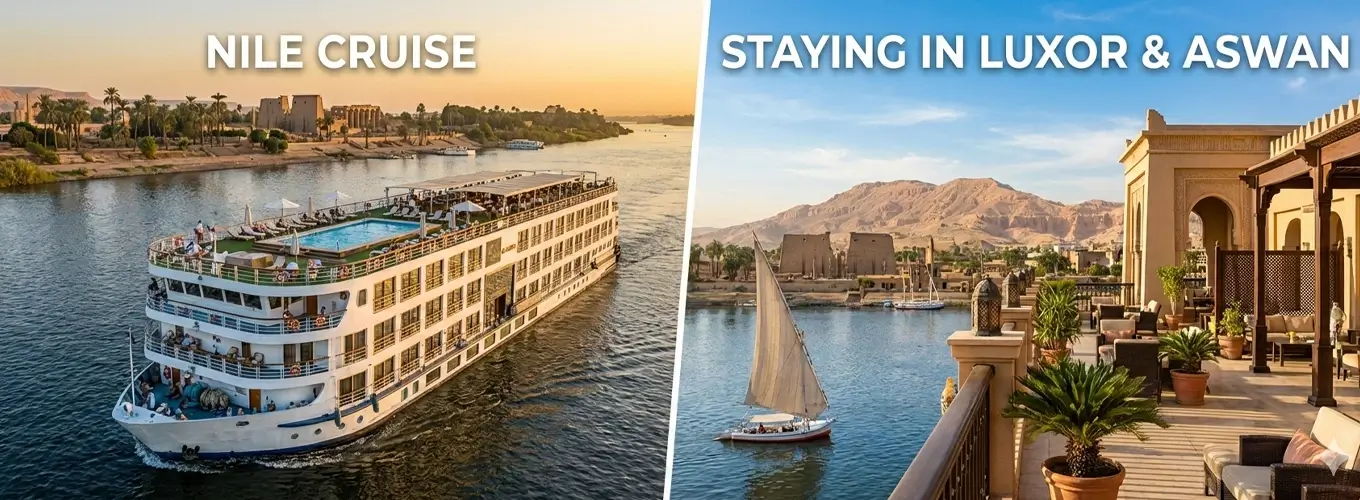
You may feel torn between the ease of a floating hotel and the pull of life on solid ground. I remember choosing a trip where I unpacked once and watched the landscape change outside my window. That calm, the expert guides, and a pool deck at sunset felt like a gift after long days of exploring.
But you might crave market mornings, dune drives, or late-night street food. Hotels let you dive into neighborhoods, try more local menus, and set your own pace. Costs can vary a lot too, so your budget could nudge your choice.
This guide from Nile Cruise Offers gives a friendly, clear comparison. You’ll see how comfort, logistics, time, price, and sustainability stack up so you can pick the way that fits your tour dreams.
Key Takeaways
- This article compares nile cruise vs staying in luxor and aswan to help your choice.
- A river option lets you unpack once and dock close to major sites with guided tours.
- Hotels offer more flexibility, local food, market access, and possible cost savings.
- Expect clear numbers on typical durations and per‑day prices to plan your budget.
- We highlight who benefits most from each approach so your trip matches your style.
Choosing your Egypt base today: what it’s like to travel between Luxor and Aswan right now
Deciding where to base your Egypt itinerary changes how each day feels on a trip. Today, most river runs follow set schedules: common options last 3 nights/4 days or 4 nights/5 days and dock close to major sites. A Nile cruise bundles guides, most meals, and shore tours so you unpack once and skip separate transfers.
Overland travel gives you timing freedom. Trains, private drivers, and occasional short flights connect cities; expect about $15 for a Cairo–Luxor train, $30–$50 per day for a driver, and guesthouses from $25–$40 nightly. You’ll book two hotel bases and handle transfers, but you can add desert detours, markets, or longer temple visits.
- Cruise days follow a fixed schedule with grouped tours and set mealtimes.
- By road you control start times to dodge heat, crowds, or linger at sites.
- Ships often dock near key sights, which saves transfer time compared to some hotels.
- Plan buffer time for rest, weather, or delays regardless of choice.
| Option | Typical days | Typical extra costs |
| River (Nile cruise) | 3–5 | Guided tours, meals included |
| Overland (luxor aswan) | Flexible | Drivers, hotels, per‑day guides |
| Mix | Custom | Combine both for variety |
Nile cruise vs staying in Luxor and Aswan: a side‑by‑side look at comfort, flexibility, and value
One option locks you into a smooth, planned schedule; the other lets you build each day around your mood.
If you pick a floating hotel, expect air conditioning, dining rooms, a pool deck, and guided tours bundled into one price. Packages usually include meals and expert-led visits to major temples over common 3–5 nights. That setup boosts comfort and removes daily logistics.
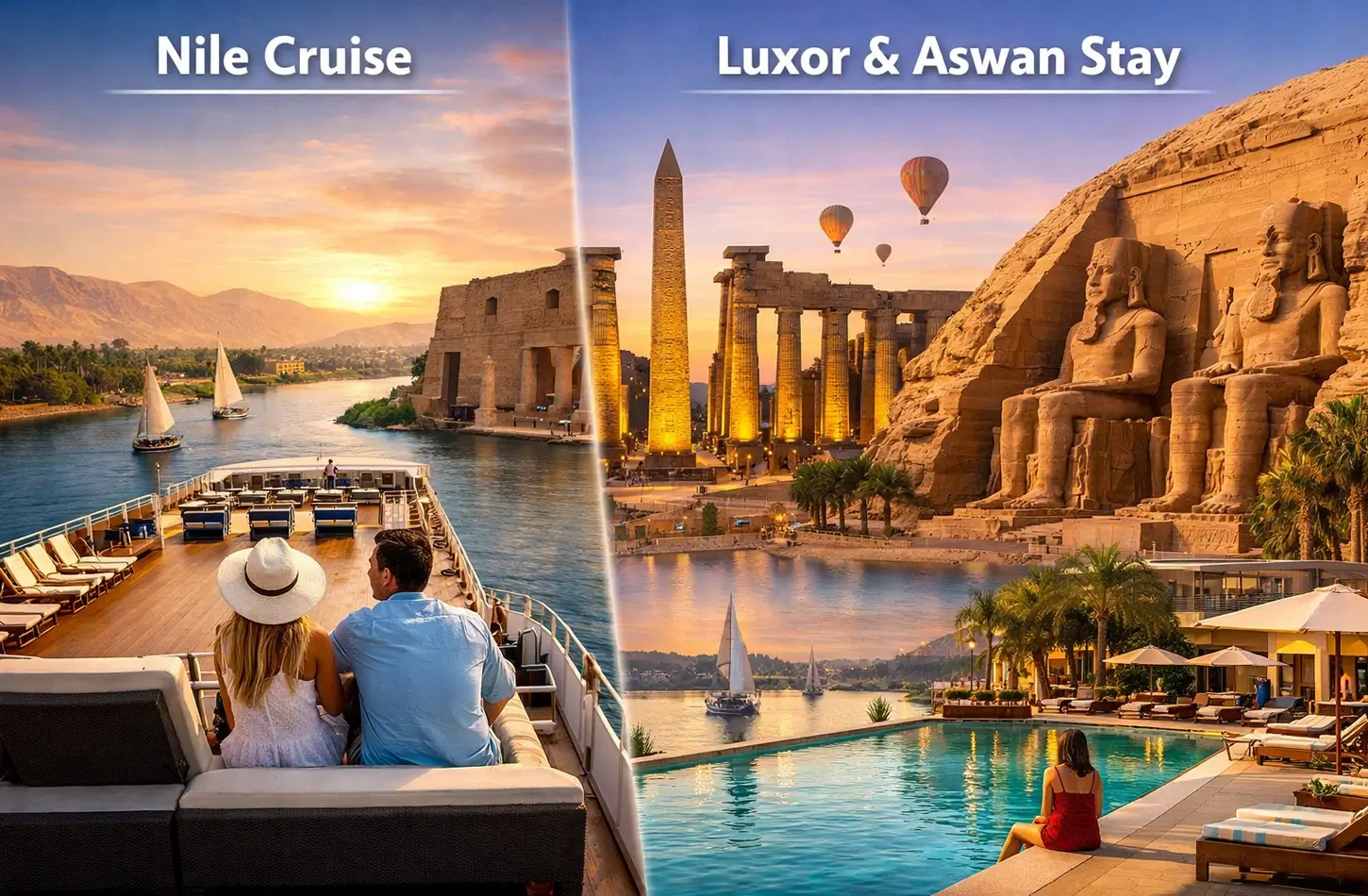
Choosing hotel bases puts you nearer markets, boutique design, and more local food choices. You will pack more, book transfers, and set your own start times to beat heat or crowds. That freedom often saves money if you shop local guides and restaurants.
- Comfort: onboard amenities vs characterful hotel stays.
- Flexibility: fixed tour windows vs control over your schedule.
- Value: all-inclusive convenience vs pick-and-pay savings.
| Feature | Floating hotel | Hotel bases |
| Typical nights | 3–5 | Flexible |
| Meals | Mostly included, international focus | Wide local choices, street food options |
| Cost range (per person/day) | $100–$250 | Often ~25% less if self‑arranged |
| Guide options | Group Egyptologist included | Private guide available on request |
Who gets the most from each option
How you like to spend mornings and evenings will quickly reveal the right travel option for you.
If you value calm, low stress days and fewer transfers, a nile cruise often suits you best. Elderly people and travelers with limited mobility benefit from short walks ashore, steady routines, and onboard assistance. Families and honeymooners also often choose this way for relaxed pacing and built-in comfort.
Active travelers who want to shape each day will prefer land-based hotels. You can start early, linger late, explore markets, and pick a specialist guide for a specific site. Independent visitors who enjoy boutique stays and food hunts gain the most from this option.
- If comfort matters, the nile cruise minimizes packing and daily logistics with a shared Egyptologist guide.
- If you want to pick your guide and set your own time, hotels let you hire specialists and extend visits.
- First-time tourist visitors often like the predictability of a cruise; repeat travelers may choose hotels for deeper immersion.
Costs, timeframes, and seasonality that shape your decision
Budget, season, and trip length often steer your choice more than comfort alone. Typical packages list per‑person per‑day rates, so compare like for like: expect about $100–$250 per person per day for a ships stay. That range usually sits roughly 25% above an overland option when you total hotels, drivers, and meals.
Common itineraries run 3 nights/4 days northbound or 4 nights/5 days the other way. Add buffer days for flights or trains when you plan arrival and departure times.
- Train, driver, and guesthouse budgets: train tickets can be ~$15; guesthouses $25–$40 per night; private drivers $30–$50 per day.
- Most packages bundle meals, guided tours, and shore transport; hotels let you pay à la carte and hire a guide only when you need one.
- January after New Year brings cooler weather, fewer crowds, and often lower prices; shoulder seasons also offer savings without extreme heat.
| Item | Typical cost | Notes |
| Ship per person/day | $100–$250 | Often includes meals, guide, and tours |
| Overland daily budget | $40–$90 | Guesthouse + occasional driver; tours extra |
| Common lengths | 3–5 days | 3 nights/4 days northbound; 4 nights/5 days reverse |
| Add‑ons | $50–$150 | Options like Abu Simbel easier from the south start |
Match your money to what you’ll use: choose bundled convenience for less planning stress, or pick hotels and day guides to control spending and extend local stays.
The experience factor: food, guiding, entertainment, and cabins
Your daily rhythm—meals, tours, and evenings—defines the mood of the whole trip. On a river option, most meals are included and lean continental with Egyptian touches. Evenings often bring themed parties, live music, or low-key cultural shows.
Modern ships offer air conditioning, pools, and small spas. Group Egyptologist guides lead visits to temples such as Edfu and Kom Ombo, so you get expert context without arranging details each day.
On land, you’ll find richer street food, vegetarian snacks, and market meals that a ship can’t match. City nights mean cafés, rooftops, and spontaneous tastings. You can hire a private guide when you want a deep dive at any temple.
- Included meals vs local dining discoveries.
- Planned onboard entertainment vs nightlife and souks ashore.
- Shared Egyptologist guide vs private guide on demand.
- Compact cabins with big windows; views may face other ships at peak docking.
| Feature | Ship option | Land option |
| Meals | Mostly included, set menus | Wide local choices, street snacks |
| Entertainment | Themed nights, live music | Cafés, rooftop views, markets |
| Guiding | Group Egyptologist for temples | Private guide available per day |
| Comfort | AC, pool, compact cabins | Boutique hotels, city or river views |
Logistics, transport, and sustainability along the Nile
How you move between sites affects time, stress, and the sights you’ll actually see.
Sailing options mean ships handle most logistics. They dock near major sights, bundle guided shore visits, and cut transfer hassle. That reduces daily stress and keeps your schedule tight.
Overland travel mixes trains, private cars, and sometimes flights. Your way can take you down desert highways, past farms, and into quiet villages that the river route misses.
- If you prefer seamless logistics, sailing keeps transport simple and predictable.
- Road travel feels more immersive but asks you to manage pickups, routes, and timing.
- For the Aswan–Luxor segment, a shared car can emit roughly 25–30 kg CO2 total, while a per‑person estimate for a ship leg can be about 57.5 kg — a factor to weigh.
- Mixing formats — sail one direction, return by road — balances scenery, time, and impact.
| Aspect | Sailing / ships | Overland |
| Logistics | Bundled, low stress | Flexible, self‑managed |
| Scenery | River views, onboard comfort | Desert roads, villages, farms |
| Emissions (example) | Higher per person on some ship legs | Lower if car shared by four |
Nile Cruise Offers clarifies these trade-offs so you can plan smart. Give yourself buffer time, pick the travel mode that fits your priorities, and enjoy the journey.
How Nile Cruise Offers helps you choose the right way to see Luxor and Aswan
We match your travel style to a clear plan so every day feels planned, not improvised. Tell us your priorities and we shape an itinerary around must‑see temples, market time, or desert outings.
Typical sail lengths span 3–5 days and include guided visits to Edfu, Kom Ombo, and Philae, with Abu Simbel as an optional add‑on from Aswan. Overland alternatives link markets, the White Desert, Saqqara, and Dashur for a deeper local rhythm.
- We compare a nile cruise package with hotel plans so you see pricing, inclusions, and pacing at a glance.
- If you pick a cruise, we curate tours with a guide you’ll enjoy and useful add‑ons.
- Prefer city stays? We match hotels with specialty guides, food stops, and easy transfers.
- Many travelers mix both: a few on‑water days plus land time for photos and markets.
| Service | Best for | Includes |
| Sail package | Easy logistics | Meals, group guide, shore transfers |
| Hotel plan | Local immersion | Private guides, tailored food stops |
| Mix | Balanced experience | Choose each part by preference |
We factor seasonality, luxury levels, and clear inclusions so your choice fits budget and pace. Ask us for a custom plan for your next trip with Nile Cruise Egypt options.
Conclusion
Think about whether you want most of your time guided between temples or free to wander neighborhoods and deserts.
If you prefer streamlined sightseeing, cruises deliver bundled guiding, meals, and easy access to major temples like Luxor, Karnak, Edfu, Kom Ombo, and Philae across common 3–5 days itineraries.
If you crave spontaneous stories—market stops, late cafés, or a desert detour—hotel stays unlock local food, varied scenery, and flexible timing.
You can mix both: sail a few days to cover core sights, then base yourself ashore to deepen the experience in luxor aswan. This post laid out the pros so your trip matches your style.
Nile Cruise Offers helps you pick dates, the best ship or hotel nights, and the tour elements that matter. Tell us your priorities and we’ll turn choice into a clear plan you can book with confidence.
FAQ
Q: What are the main differences between taking a Nile cruise and basing yourself in Luxor and Aswan?
A: A cruise gives you door-to-door sightseeing with cabin comfort and on-board meals, while staying in hotels in both cities lets you explore at your own pace and enjoy local restaurants. Cruises bundle transport, guides, and entertainment; land stays offer more flexibility for longer time at specific sites and deeper contact with local life.
Q: How much time should I allocate to see key temples if I pick one base over the other?
A: For either option, plan at least two full days per city for major sites like Karnak, the Valley of the Kings, Philae, and the Unfinished Obelisk. A four- to seven-day trip combining both gives you relaxed visits and time for lesser-known temples and a felucca ride.
Q: Is one option more comfortable or less stressful for first-time visitors?
A: Cruises reduce logistical stress: transfers, meals, and daily sightseeing are organized for you. Staying on land gives you more control but requires more planning, arranging taxis, tickets, and guides. If you prefer predictable comfort, a ship is often easier.
Q: How do costs compare between a multi-night ship trip and hotels in Luxor plus Aswan?
A: Prices vary by season and level of comfort. All-inclusive cabins can seem pricier upfront but often include guides, entrances for scheduled tours, and most meals. Hotels may look cheaper per night, but private transfers, guided tours, and entry fees add up. Shop deals and compare final totals.
Q: What about food quality and meal options on board versus on land?
A: Ships typically serve buffet and plated meals with international and Egyptian dishes included. Hotels and local restaurants offer a wider range of authentic street food and fine dining. If you have dietary needs, check menus in advance for both choices.
Q: Are guided tours better on ships or when staying in Luxor and Aswan?
A: Ships work with licensed Egyptologists for scheduled shore excursions, ensuring consistent guides. Staying on land lets you hire private guides for tailored itineraries and longer deep-dive tours. Both give high-quality guiding if you book reputable operators or agencies.