

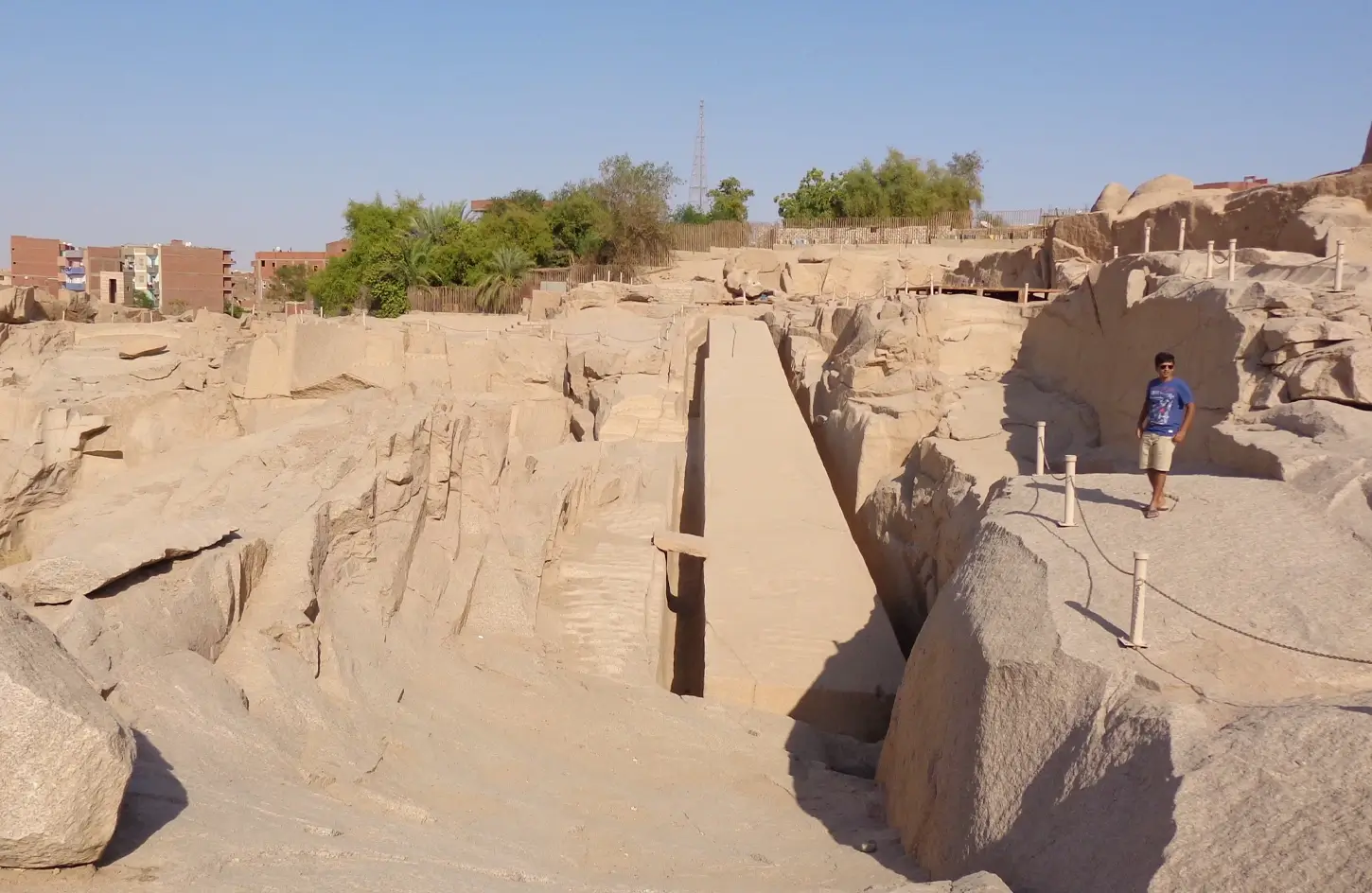
The Unfinished Obelisk at Aswan is believed to be the biggest ever ancient Egyptian obelisk that never left its place of creation due to having a crack in the rock of about 42 meters long and weighing about 1,200 tons. Had it been successfully created, it would be almost twice the height of any other obelisk found in Egypt.
My name is Mohamed Atta and guiding visitors around Aswan granite quarries is my job. It is one of my favorite visits during the Aswan day tour as it is not as pretty as Philae Temple, but it is honest and I feel like I am standing inside a place where the construction process is being interrupted for thousands of years. Here is everything you should know about the place: its history, reasons why the project was interrupted, how ancient Egyptians created their granite obelisks and what you will see there.
What Is the Unfinished Obelisk?
Just as its name indicates, The Unfinished Obelisk is an obelisk that was started by workers of ancient Egypt and was left unfinished while being carved out of bedrock in the northern quarries of Aswan. The reason why it stands out from all other obelisks that you might find at the entrance to temples in Luxor, Karnak, or even in Paris and Rome, is the fact that it never moved from its birthplace.
Quick facts:
| Detail | Figure |
|---|---|
| Duración | Approximately 42 meters (137 feet) |
| Estimated weight if completed | Around 1,200 tons |
| Material | Aswan granite (syenite) |
| Likely commissioned by | Queen Hatshepsut, 18th Dynasty |
| Status | Three sides carved; never detached from bedrock |
| Location | Northern Quarries, Aswan |
As a point of comparison, the standing obelisks of Karnak Temple weigh approximately 320 tons each, while the Luxor Obelisk relocated to Paris weighs around 225 tons. If this one had been completed, it would have been the largest individual piece of stone that ancient Egyptians tried moving, weighing four times as much as any other object they managed to move.
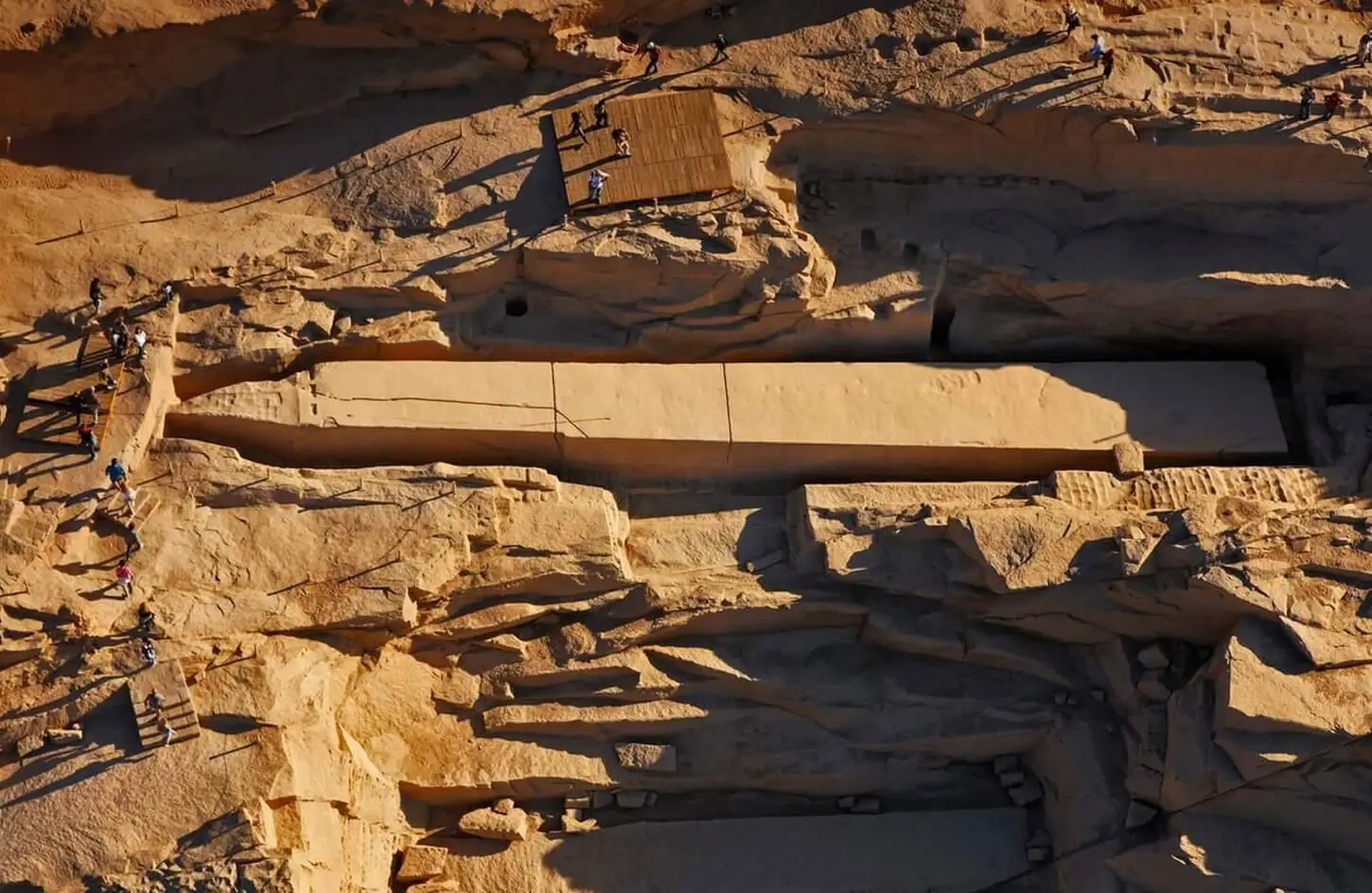
The importance of the site goes beyond its weight because you get a rare chance of seeing the whole quarrying process in front of your eyes: the trenches dug around the stone for its separation from bedrock, chipping marks left from granite quarrying work, and the crack that stopped the whole process. This is probably the only place in Egypt where you can get an insight into the actual quarrying process instead of just the results of it.
How Ancient Egyptians Carved an Obelisk From Solid Granite
This is the stage which people are typically most interested in, and it deserves an explanation as the technique used was truly brilliant for a society that had no access to iron implements.
The carving process, step by step:
- Selection of the bedrock. The quarrymen selected a piece of granite that did not have any imperfections on it – although the presence of imperfections was difficult to detect in many cases, as is evident from this obelisk.
- Outlining the shape. The outline of the obelisk was drawn on the rock surface before digging trenches to isolate the obelisk from the rest of the stone.
- Pounding rather than cutting. The Egyptians did not use blades to cut through granite as this was too hard; instead they pounded it into dust using dolerite stones, which were harder than granite stones.
- Wedges and water method. When the trench had been dug to an appropriate depth, workers inserted wedges in the cracks along the line of future splitting, which were then watered to cause the expansion of the wood.
- Smoothing and engraving. For an obelisk ready for transport, the next step included the smoothing of the surface and engravings — dedication inscriptions to the gods and to the pharaoh who ordered it to be made. The Unfinished Obelisk was never processed at this point on the lower surface of the stone, hence all the traces of work are visible now.
The evidence of dolerite processing can be clearly seen on the surface of the stone and the trenches dug around three of its sides. This is a unique opportunity to see Bronze Age engineering at work — no other obelisk in Egypt provides such an insight into this process.
The Unfinished Obelisk is only one of Aswan’s remarkable attractions. Discover more unforgettable experiences, historical sites, and hidden gems in our complete guide to the best things to do in Aswan.
Why Was the Unfinished Obelisk Abandoned?
The short answer: a crack appeared in the granite late in the carving process, and once that happened, the project couldn’t continue.
The quarry laborers had begun digging trenches around three sides of the obelisk and were about to begin the process of extracting it from the rock face when they uncovered a fracture going right through the block of granite. Internal pressure from fractures makes granite very unpredictable; it only took a minor flaw that would not have been noticeable before carving to make the entire block too fragile to move.
It was simply not feasible to extract the block in this condition. Moving a flawless block of this size (1,200 tons) from Aswan to the temple site was as far as ancient Egyptians could go in terms of engineering capabilities; trying to move a fractured block would have been impossible.
Thus, there was little else to do but cease operations on this obelisk. It remained exactly as it was – partially attached to the rock face – until it was discovered and excavated by archaeologist Reginald Engelbach in 1922.
And there is an important lesson to be learned from this crack, a lesson which I like to impart to any group I am leading around the site: even when they had reached the pinnacle of their technical capabilities, the ancient Egyptians were still working right up against the limits of survival for their stone and for themselves. There were some projects which did not succeed – and they offer us lessons which the monuments never can.
After exploring the ancient quarry of the Unfinished Obelisk, continue your Aswan adventure with a visit to the colorful Nubian Village, where you can discover the unique traditions, culture, and warm hospitality of the Nubian people.
Who Commissioned the Unfinished Obelisk?
The obelisk is generally believed to belong to Queen Hatshepsut, who was one of the greatest rulers of ancient Egypt and perhaps one of the very few women rulers who ascended the throne of Pharaoh in her own time, belonging to the 18th Dynasty. Some scholars have suggested that it could have belonged to some other ruler of the time as well, but the Hatshepsut theory seems more convincing to the Egyptologists.
In case if this attribution is true, the destination of the obelisk would definitely be Karnak Temple as a partner to one of the many obelisks erected by Hatshepsut at Karnak Temple. There was an obelisk of Hatshepsut at Karnak Temple, measuring 29.5 meters and belonging to the category of some of the tallest obelisks of Egypt.
It is precisely such ambition that characterized the reign of Hatshepsut. Not only did she oversee large building projects all over Egypt, but she also constructed the obelisks at Karnak to highlight her immense power and dedication to the god Amun. If successful, the Unfinished Obelisk would be her most daring attempt yet, and the simple fact that even she could not surpass the flaw in the rock suggests the inherent limitations of the ancient builders.
Don’t miss the chance to visit the breathtaking Abu Simbel Temples, one of Egypt’s greatest ancient masterpieces, famous for their colossal statues and fascinating history.
Visiting the Unfinished Obelisk Today
The Unfinished Obelisk is located in the Northern Quarries which is not far from the main city of Aswan, and this place is probably one of the easiest-to-reach archaeological sites in Egypt; however, you’ll need an informative guide for your visit there.
Visit planning at a glance:
| Detail | Qué esperar |
|---|---|
| Recommended time onsite | 30–45 minutes |
| Best time to visit | Early morning or late afternoon, for cooler temperatures and better light on the stone |
| Entry | Ticketed entrance, usually arranged through your guide or cruise excursion |
| Walking | Mostly flat with some uneven quarry terrain; a marked path leads to the main obelisk and viewing platforms |
| Facilities | Restrooms onsite; small souvenir stalls near the exit |
| Typical pairing | Aswan High Dam and Philae Temple, as part of a standard Aswan day excursion |
There is just one way around the quarry, passing the small stone works and carvings, before arriving at the big obelisk. There is actually an area set aside for trying out the dolerite stone pounding process on a practice stone — an experience that seems to appeal more to children and skeptical visitors than the most eloquent of explanations.
This is normally one of those places that is bundled along with the High Dam and Philae Temple when visiting Aswan from the Nile — as in, for example, the tour offered by Soleil Nile Cruise and Steigenberger Legacy Nile Cruise. These two particular Nile cruises make the perfect Aswan tour itinerary because they take in all of these sites in chronological order: the quarry, the temple that would have been embellished by the obelisks there, and the High Dam that changed the course of this part of the Nile.
The Unfinished Obelisk vs. Egypt’s Standing Obelisks
The Unfinished Obelisk will have a different meaning when you realize the scale comparison – this is the one which would have been the largest obelisk and here’s how it compares to the others.
| Obelisk | Height | Estimated Weight | Status |
|---|---|---|---|
| Unfinished Obelisk, Aswan | ~42 m | ~1,200 tons | Never completed or moved |
| Hatshepsut’s Obelisk, Karnak | ~29.5 m | ~320 tons | Standing at Karnak Temple |
| Luxor Obelisk, Paris (Place de la Concorde) | ~23 m | ~225 tons | Relocated to France in 1836 |
| Lateran Obelisk, Rome | ~32 m | ~455 tons | Relocated to Rome in antiquity |
It is quite apparent. In fact, even the tallest obelisks ever to be carved, transported, and erected from temples all throughout Egypt and beyond were considerably shorter and lighter compared to the Unfinished Obelisk. This is precisely what makes this place so special: It is not only about a failed attempt; it is tangible evidence of how far ancient Egyptian technology was able to take the matter.
Every obelisk that has been erected in Egypt or Paris, Rome, London, or New York City once looked like this. All obelisks that can be found in various places around the world were extracted from this very Aswan quarry in the form of raw granite, chiseled out using dolerite implements, and successfully transported and erected without the use of any modern equipment.
Planning to continue your journey along the Nile? Learn everything you need to know about Nile Cruise safety, travel tips, and what to expect for a comfortable and secure experience.
Frequently Asked Questions
What is the Unfinished Obelisk of Aswan?
It is the largest unfinished obelisk ever carved by ancient Egyptians, found in the Northern Quarry of Aswan. The work on this monument ceased when a crack was detected in the stone during carving, thus, the stone about 42 meters tall is partially detached from the bedrock now.
Why wasn’t the Unfinished Obelisk of Aswan finished?
Late in the process of carving of the monument a crack appeared in the granite. Moving such a big obelisk was already a feat for that era; moving one which had a flaw in itself could not be considered safe, hence, the work was ceased right there.
For whom was the Unfinished Obelisk of Aswan originally made?
The Unfinished Obelisk is usually thought to have been commissioned by Queen Hatshepsut of the 18th dynasty, possibly as a companion obelisk to the obelisk she already had at Karnak Temple, but there are other opinions on that.
What size is the Unfinished Obelisk?
It is around 42 meters (137 feet) in length and would have been about 1,200 tons in weight if completed – four times that of the largest standing obelisk in Egypt.
How long will it take for me to visit?
The average time required by visitors to cover the quarry pathway and observe the obelisk along with its explanation by the guide ranges between 30 to 45 minutes.
Can I add other sites in Aswan to my itinerary with the Unfinished Obelisk?
Yes. The Unfinished Obelisk is usually combined with the Aswan High Dam and the Philae Temple on a typical Aswan day trip as part of Nile cruises.
Should I visit the Unfinished Obelisk?
Certainly yes, if you are interested in ancient engineering because it is one of the rare places in Egypt where you can actually see the process of carving stones.
Final Thoughts — Why the Unfinished Obelisk Matters
I have been showing many tourists around various temples in Egypt, and most of them are built to be awe-inspiring through their completion, including high columns, painted roofs, and statues that survived the past three millennia. The Unfinished Obelisk is totally different, which is why it will always remain memorable for me.
This is an unfinished construction site where you get to see a project weighing 1,200 tons which just got unlucky. This makes one think of ancient Egypt not as a completed myth but a functioning civilization that could both plan grand things and fail.
Should you be putting together an itinerary in Aswan, then this is definitely not something that you want to rush. Combining it with the Aswan High Dam and Philae Temple will give you the complete circle of the day, starting from ancient engineering, then moving onto sacred architecture, to modern engineering in a matter of just a few kilometers. And if you have plans to cruise along the Nile, then rest assured that this exact order is incorporated in almost any Aswan tour day on our luxury and regular sailings along the Nile.
