

QUICK ANSWER
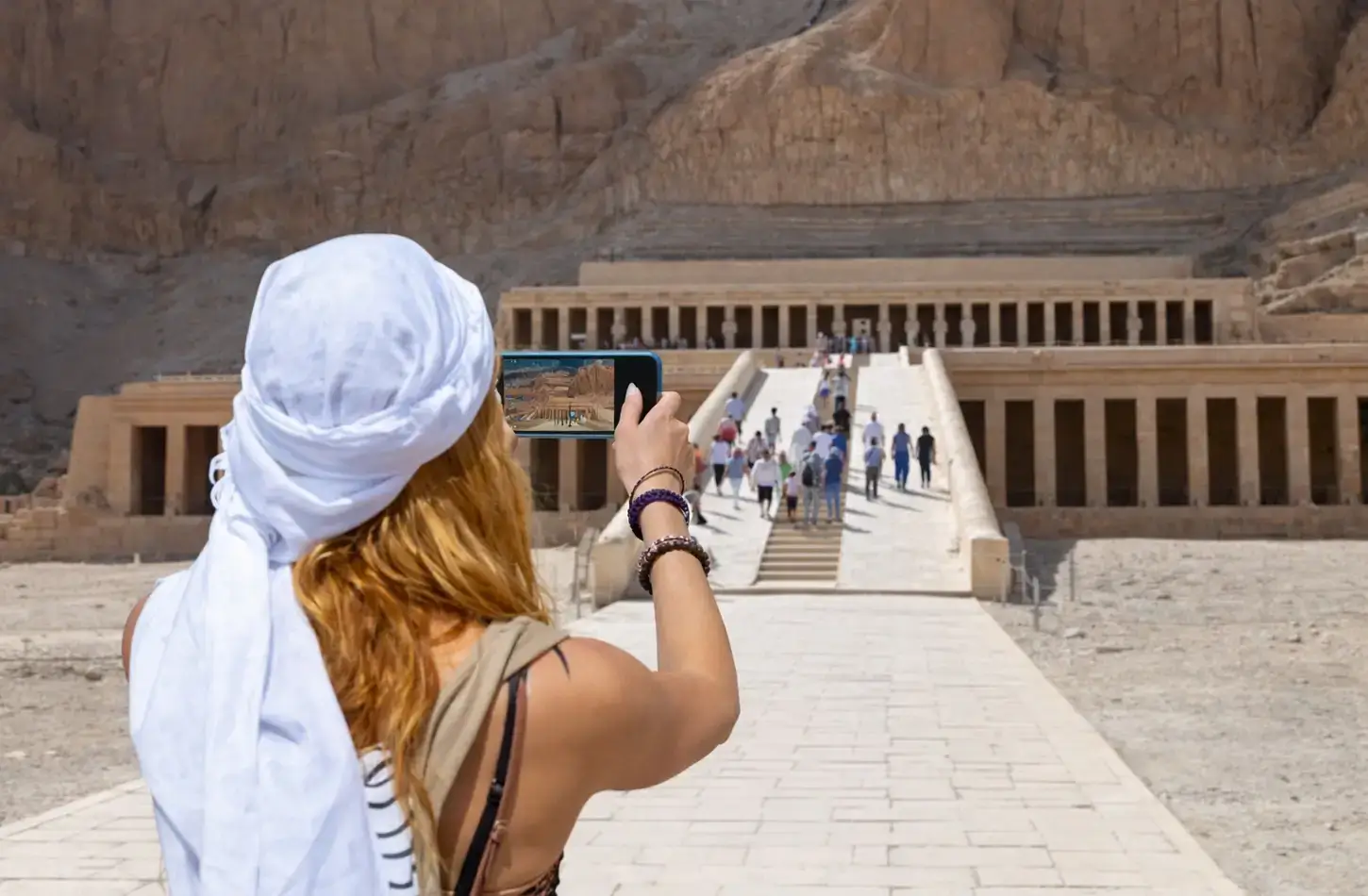
The Temple of Hatshepsut — ancient name Djeser-Djeseru, ‘Holy of Holies’ — is a terraced mortuary temple built around 1473 BCE on Luxor’s West Bank at Deir el-Bahari. Designed by the architect Senenmut for Pharaoh Hatshepsut, one of ancient Egypt’s most successful rulers, it rises in three colonnaded levels against 300-metre limestone cliffs. Entrance is covered by the standard West Bank ticket (EGP 300 for foreign visitors). Open daily 6:00 AM – 5:00 PM (summer) / 6:00 AM – 4:00 PM (winter).
There are some beautiful temples in Egypt. However, there is Deir el-Bahari, which stands out. While Karnak presents itself by its size and the amount of tourists it attracts, Deir el-Bahari presents itself subtly. It appears just after you make a turn on Luxor’s West Bank – three symmetrical terraces made of white limestone, perfectly fitting in with the golden cliff wall behind, with the whole construction looking like carved right into the mountain.
Mohamed Atta, Upper Egypt expert of Nile Cruises Offers, has organized tours to Deir el-Bahari for dozens of cruise groups during his career. ‘Every time’, he said, ‘people are getting silent the first time they see it. Not every monument can do this.’ This guide benefits from his expertise in order to provide you with information, which is not mentioned in most tour guides: the story behind the stone and the best ways of visiting the temple on your Nile cruise itinerary.
Temple of Hatshepsut — Key Facts
| Fact | Detail |
|---|---|
| Ancient name | Djeser-Djeseru (‘Holy of Holies’) |
| Built by | Pharaoh Hatshepsut, 18th Dynasty |
| Architect | Senenmut, Royal Steward & Chief Architect |
| Construction period | c. 1473–1458 BCE (~15 years) |
| Type | Mortuary temple dedicated primarily to Amun-Ra |
| Location | Deir el-Bahari, West Bank, Luxor |
| UNESCO listing | 1979 (part of Ancient Thebes & Necropolis) |
| Architecture style | Three terraced colonnades connected by central ramps |
| Height of cliff backdrop | ~300 metres (1,000 ft) |
| Entrance fee (foreign) | EGP 300 (West Bank ticket — covers multiple sites) |
| Entrance fee (Egyptian) | EGP 30 |
| Opening hours (summer) | 6:00 AM – 5:00 PM (April–September) |
| Opening hours (winter) | 6:00 AM – 4:00 PM (October–March) |
| Typical visit duration | 60–90 minutes |
| Best time of day | Early morning (before 9:00 AM) or late afternoon |
| Shuttle bus on site | Available — short ride from entrance gate to ramp |
| Distance from Luxor city | ~6 km west (30–40 min including Nile crossing) |
Who Was Hatshepsut?
Before the temple makes sense, the woman who built it has to.
A Queen Who Became Pharaoh
Hatshepsut was born around 1507 BC, being the daughter of Thutmose I, a warrior ruler of Egypt. Hatshepsut married her half-brother, Thutmose II, and after his untimely death, the kingship passed to his little son by another wife: Thutmose III. Hatshepsut took the role of the regent, the female ruler who ruled in the name of the young boy king.
In about 1473 BC, Hatshepsut made an unprecedented move: she declared herself to be a pharaoh.
Not regent. Not the queen. The Pharaoh – with all the necessary royal titles, the double crown, crook and flail, and ceremonial false beard, which were always depicted in Egyptian iconography. She was not the first woman in royal position in Egypt, but the most successful one who reigned for nearly 20 years at the times of peace and prosperity.
What She Built and What She Traded
Hatshepsut ruled during a period in which Egypt saw some of its most monumental constructions. She built two colossal obelisks in Karnak, each measuring 29 meters tall, making them the tallest obelisks ever built in Egypt up to that point. She re-established trade routes that had been cut off due to the Hyksos invasion and launched a legendary expedition to Punt, a rich coastal nation believed to exist in today’s Eritrea or Somalia.
The expedition to Punt is recorded through the most famous reliefs in the temple: ships of Egypt arriving in the round house villages raised above water, trading of gold, myrrh trees, ebony, and animals, and the queen of Punt being portrayed in great physical detail welcoming the Egyptian ambassadors. This is the most comprehensive record available of an Egyptian trading voyage.
Complete your Luxor experience with a visit to the iconic Luxor Temple, a masterpiece of ancient Egyptian architecture famous for its grand columns, impressive statues, and fascinating history.
The Erasure
Hatshepsut died in 1458 BCE. The long-suffering Thutmose III finally – maybe 25 years after her death – launched a full-on campaign to erase all record of her ever having lived. Statues were shattered. Names were hacked out of inscriptions. Images were covered up with Thutmose I, Thutmose II, or blank stone.
It almost worked. For hundreds of years, scholars who examined the temple were baffled about the identity of its architect. Not until the nineteenth century did Egyptologists put the clues together and identify the obliterated pharaoh as a female.
This act of historical vandalism is one of the reasons why Hatshepsut’s story is so compelling. It’s one of the stories you’re hearing as you pass through Deir el-Bahari – an achievement that has seen off everything life could throw at it.
The Architecture of Djeser-Djeseru
There is nothing else like the Temple of Hatshepsut in all of Egypt, and there is more to the design of this ancient edifice than just its location.
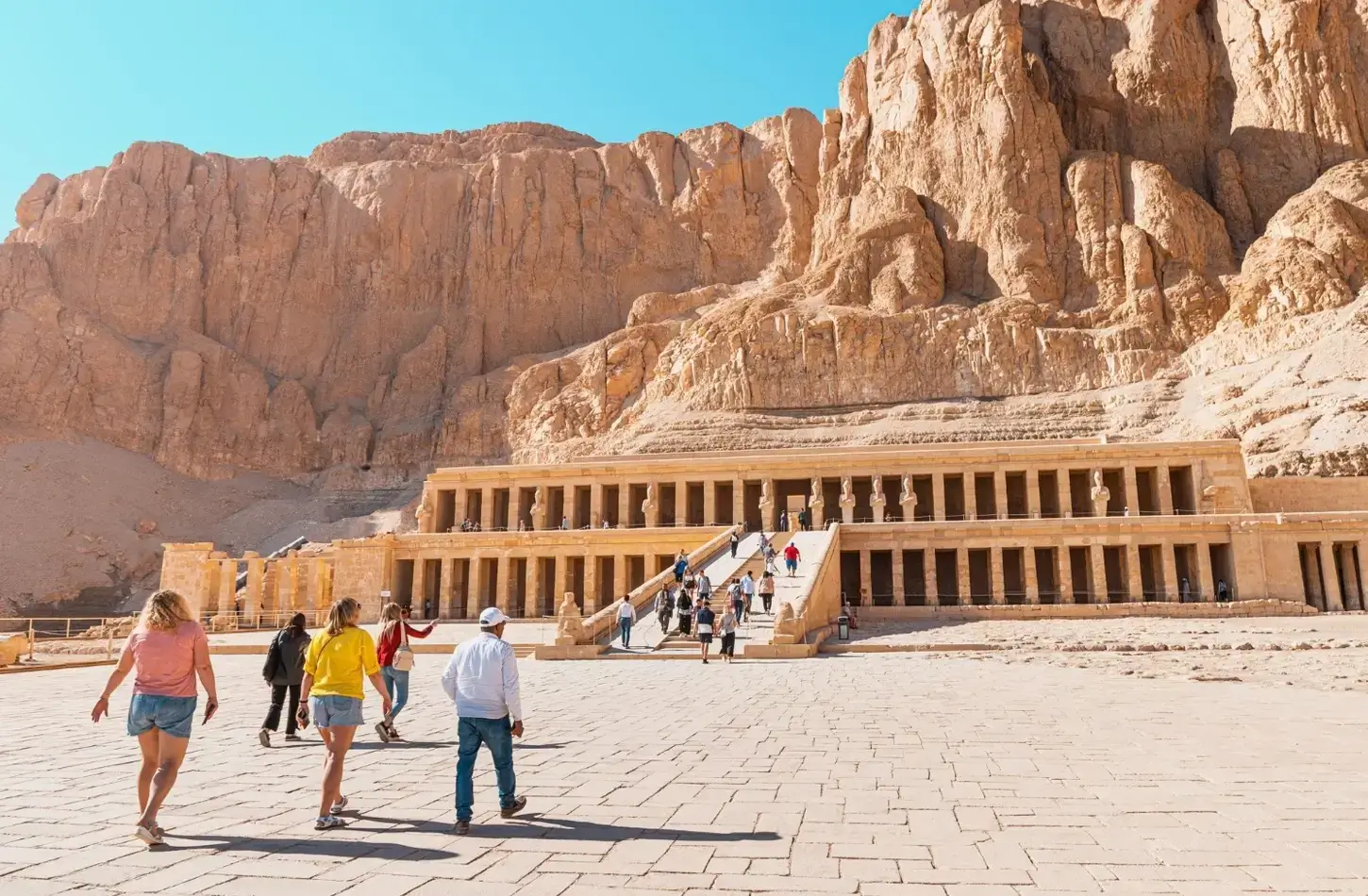
While many of the temples found in the New Kingdom era of Egypt were horizontal structures stretching from the entrance pylon, the Temple of Hatshepsut was an example of vertical design with three successive terraces of colonnaded walls stacked on top of one another and linked with a ramp running down the center of each level.
This structure was obviously influenced by the adjacent mortuary temple of Mentuhotep II, but Senenmut raised the bar for royal Egyptian architecture with his designs.
Planning to sail between Luxor and Aswan? Read our complete Nile Cruise safety guide to discover useful travel tips, security information, and everything you need for a relaxing and safe journey.
Integration with the Cliff
The temple does not stand before the cliff; it emerges out of it. The uppermost sanctuary, which was called the Holy of Holies and served as the dwelling place for Amun-Ra, was cut directly out of the rock. The lower terraces, on the other hand, extend outward from the mountain in complete alignment with the four cardinal points such that sunlight strikes the inner chamber of the sanctuary on the morning of the Festival of Opet.
What is now barren rock, however, once had vegetation growing on it, including frankincense and myrrh, which came from the land of Punt; vines; and exotic plants from all over Egypt. Flanking the approach were reflecting pools, while sphinx-lined avenues preceded the ramp leading up to the temple. None of this now exists, but the framework remains largely intact.
Senenmut
Not only does the person who built the temple interest us, but the one who ordered its construction is no less of a mystery. Senenmut was the Royal Steward to Hatshepsut, a teacher to Hatshepsut’s daughter Neferu-Ra, and according to all architectural evidence, he was a highly skilled designer and possibly the best designer Egypt ever had. Not only did they know each other professionally, but there is evidence found on ancient graffiti near the temple depicting caricatures indicating a closer personal relation, but nothing can be confirmed yet.
Senenmut died and was buried near Deir el-Bahari. As Hatshepsut, his name was also erased from many inscriptions.
What You’ll See — Terrace by Terrace
The visitor experience moves through three levels from bottom to top. Here’s what to look for at each.
Lower Terrace
Your journey starts when you cross the desert plateau via the processional causeway from the valley temple at the banks of the Nile. There is a free bus shuttle service that takes visitors to the bottom of the ramp from the entry gates. Many people use this service, but walking is possible in cooler months.
The garden was on the lower terrace. Now it is an open area surrounded by two colonnades. The rear wall of the northern colonnade originally contained the scene of the conveyance of Hatshepsut’s two large obelisks from the granite quarries at Aswan, where there is the famous “Unfinished Obelisk” that had cracked before its completion, to the Karnak Temple by barges. Colossal Osirides of Hatshepsut, represented in the traditional funerary form of the god Osiris, once stood between the columns. Some statues were restored.
Middle Terrace — The Narrative Heart
This is where the story of the temple unfolds and what makes this temple unique even in Egypt.
In the south colonnade, one can see Punt reliefs, which are scenes illustrating Hatshepsut’s expedition to Punt. In contrast to many other scenes of ancient Egypt, these reliefs are depicted in great documentary detail with precise identification of the plants, animals and people involved as well as the landscape of the region. This latter feature was used by researchers to argue about the probable location of the expedition for more than a hundred years. The colouring on the relief is washed out by time, but the scene is preserved in great detail.
The north colonnade holds Divine Birth scenes. These scenes depict the story of how Hatshepsut was born and legitimized. Namely, god Amun disguises himself as Hatshepsut’s father Thutmose and impregnates Hatshepsut’s mother, Ahmose. As a result, she gives birth to the god’s daughter.
Flanking the terraces are two chapels:
- Hathor Chapel (South Side) – dedicated to the goddess of love, music, and fertility. The columns are adorned by special Hathor headed capitals – a female face with cow ears, which is unique for all Egyptian temples. Part of the decoration of the chapel is still preserved.
- Anubis Chapel (North Side) – dedicated to the jackal-headed god of embalmment and death. It is smaller than Hathor’s chapel, but it has beautiful and well-preserved relief paintings in blue and ochre colors.
Travel deeper into Egypt’s ancient past by discovering the remarkably preserved Edfu Temple, dedicated to the falcon god Horus and considered one of the best-preserved temples in Egypt.
Upper Terrace — Djeser-Djeseru
The topmost area is the most sacred one and the most extensively damaged – Thutmose III’s acts of obliteration were the most complete in this area.
At the middle of this level is the temple of Amun-Ra. On either side of the sanctuary is the chapel of the solar barque of Amun-Ra, the chapel of Thutmose I and that of Hatshepsut herself. The latter one is a funerary cult of Hatshepsut which involved ritual acts performed in order to preserve her spirit after her death. At the far end is the sanctuary of Ra-Horakhty, who was the combined form of the sun god.
The majority of relief carving at the top terrace has been defaced, but there is enough left to understand what was originally meant to be there.
The Erasure, the Rediscovery, and the Restoration
Thutmose III’s Campaign
The elimination of Hatshepsut from monuments in Egypt did not occur all at once. The reign of Hatshepsut was shared with Thutmose III – he led the armies of Egypt while she ruled – and it seems that Thutmose waited until the end of his reign before he had Hatshepsut’s names and images erased. The motivation behind his actions has been much debated by historians and could be due to political, religious, jealous, or purely personal reasons.
However, the consequences were long lasting and even today there is some confusion regarding who built the temple.
Rediscovery
Excavation by European archaeologists took place in 1850 and 1890. Polish-Egyptian Archaeological Expedition, headed by Mieczysław Marciniak and later Zbigniew Szafrański, has been doing meticulous restoration at the site from 1960 until now. Almost everything you see there is genuine stone put back into its proper place.
Hatshepsut Temple on Your Nile Cruise
For the vast majority of visitors who see this temple, it happens during a Nile cruise West Bank day in Luxor. Here’s how it fits.
Which Day of Your Cruise?
During a regular 4-night cruise on the Nile between Luxor and Aswan, the West Bank would be visited on Day 1; that is, the afternoon or morning following your first departure at Luxor. In the case of a 3-night cruise between Aswan and Luxor, the West Bank would be visited during the last morning prior to your disembarkation. The ship will anchor on the East Bank at Luxor and you would travel to the West Bank by ferry or road bridge.
The Standard West Bank Day — Sequence & Timing
| Site | Approx. Time | Notes |
|---|---|---|
| Colossi of Memnon | 15–20 min | First stop — two 18-metre seated statues; photo stop, no interior |
| Temple of Hatshepsut | 60–90 min | Main stop; allow 90 min if you want to explore properly |
| Valley of the Kings | 90–120 min | Ticket covers 3 tombs; Tutankhamun’s tomb costs extra |
Some cruise routes may also include the Karnak Temple in East Bank as a visit during the evening (Karnak looks great in artificial light). If time permits, you could visit Medinet Habu (the mortuary temple of Ramesses III), which is much less crowded compared to Hatshepsut Temple.
The Nile Cruise Advantage
Tourists generally arrive at the West Bank by 7:30–8:00 AM, which is earlier than the bus tours coming in from Hurghada starting at 9:30 AM. There is quite a difference in number of people visiting the Hatshepsut Temple from 7:30 to 10:00 AM. If you have booked your cruise with a West Bank tour, it’s better to be in one of the earliest transfer trips.
Check out our Nile cruises for details of Nile cruises that offer visits to Luxor West Bank sites with Egyptologist guides, timing your visit before the Hurghada crowds arrive at Deir el-Bahari.
After exploring the magnificent Temple of Hatshepsut, continue your journey into ancient Egypt by visiting the Valley of the Kings, the royal burial ground of pharaohs and home to some of the most spectacular tombs ever discovered.
Practical Information for Visitors (2026)
| Detail | Information |
|---|---|
| Entrance fee (foreign) | EGP 300 — West Bank ticket (covers Hatshepsut + Colossi of Memnon; Valley of the Kings separate) |
| Entrance fee (Egyptian) | EGP 30 |
| Opening hours (Apr–Sep) | 6:00 AM – 5:00 PM daily |
| Opening hours (Oct–Mar) | 6:00 AM – 4:00 PM daily |
| Shuttle bus on site | Free; runs from entrance gate to temple ramp |
| Photography | Permitted throughout; no flash inside chapels |
| Documents required | Passport (foreign visitors) |
| Getting there (from Luxor East Bank) | Ferry across Nile (~EGP 5) + taxi; or road bridge + taxi. Total: 30–40 min |
| Getting there (Nile cruise) | Ship’s excursion desk arranges transfer |
| Best time of day | Before 9:00 AM (before Hurghada buses arrive) |
| Best season | October–April (temperatures manageable) |
| Summer heat warning | Cliff walls trap heat; July–August temperatures can exceed 45°C at the site |
| Water | Bring at least 1.5 litres; limited vendors on site |
| Typical visit duration | 60–90 minutes |
| Combine with | Valley of the Kings, Colossi of Memnon, Medinet Habu, Karnak Temple |
Frequently Asked Questions
What is the Temple of Hatshepsut?
Temple of Hatshepsut, which has its original name as ‘Djeser-Djeseru’ or ‘Holy of Holies’, is a rock-cut mortuary temple constructed about 1473 BCE in the West Bank of Luxor at Deir el-Bahari. This mortuary temple was built by the order of Pharaoh Hatshepsut, one of the most successful pharaohs ever ruled in ancient Egypt. The design of the temple was created by the chief architect of Hatshepsut, Senenmut.
How much does it cost to visit the Temple of Hatshepsut?
The entrance fee for tourists is EGP 300; this is the same fee charged for a general entry to the West Bank, which includes the Hatshepsut Temple and the Colossi of Memnon. The Valley of the Kings has a separate ticket that costs EGP 30. Tutankhamun’s Tomb requires an extra fee.
What are the opening hours of Hatshepsut Temple?
Temple opening time is daily throughout the year. Summertime (April – September): 6:00 AM to 5:00 PM. Wintertime (October – March): 6:00 AM to 4:00 PM. Early morning before 9:00 AM is highly recommended to escape crowd and excessive heat.
How long does a visit to Hatshepsut Temple take?
The typical duration of the visit is 60 to 90 minutes. If one wishes to study the reliefs of Punt in greater detail, as well as visit the chapels of Hathor and Anubis and walk around on the upper terrace, then 90 minutes will be required. However, a visit of 30–45 minutes is also possible.
Who was Hatshepsut?
Hatshepsut (c.1507-1458 B.C.) was an Egyptian pharaoh during the 18th Dynasty of ancient Egypt. She reigned for about 20 years, first as a regent queen for her stepson Thutmose III, and later as a pharaoh with full royal names and titles. Her rule was characterized by peace, prosperity, trade (most famously the journey to Punt), and massive construction projects. Posthumously, Thutmose III tried to obliterate Hatshepsut’s memory from history by defacing all statues and inscriptions of her.
Who built the Temple of Hatshepsut?
The temple was built by the Pharaoh Hatshepsut, and it was designed by Senenmut, the Royal Steward and Chief Architect to Hatshepsut. It took about 15 years, from 1473 BCE to Hatshepsut’s death in 1458 BCE, for the building to be completed. The location of the construction was picked next to the older mortuary temple of Mentuhotep II.
Can you visit Hatshepsut Temple during a Nile cruise?
Yes, it is one of the most popular sites visited on day trips to the Luxor West Bank which are included in practically every itinerary for Nile cruises. Tourists visiting by ship have one major benefit, since they are usually brought on board at very early morning times which allow them to reach the site before big tourist buses from Hurghada and Sharm el-Sheikh arrive.
What are the Punt Reliefs at Hatshepsut Temple?
The Punt Reliefs are a series of carved reliefs located in the south colonnade of the middle terrace representing the voyage that Hatshepsut undertook to the Land of Punt, which was a wealthy coastal civilization that possibly existed in modern day Eritrea or Somalia. They depict the ships used by the Egyptians, the exchange of gold, myrrh trees, ebony, and various exotic animals, as well as the unique buildings that characterized the civilization of Punt.
Why was Hatshepsut’s image removed from the temple?
However, after Hatshepsut’s demise circa 1458 BCE, the individual that took the helm after her, namely Thutmose III, decided to launch an attack against the memory of Hatshepsut by attempting to erase all evidence of her existence from various monuments scattered throughout Egypt. There are disagreements about the timeline and motives behind this move, which seem to be done toward the end of Thutmose III’s reign out of political or succession considerations.
Is photography allowed at the Temple of Hatshepsut?
Photography is allowed at all locations in the site. The use of flash photography is not allowed in the chapels, especially the chapel of Hathor and Anubis, to preserve the paint on the walls. The light that comes in early mornings is ideal for photographing from the terraces, as the backdrops of the temples become golden due to the rays of the rising sun.
